
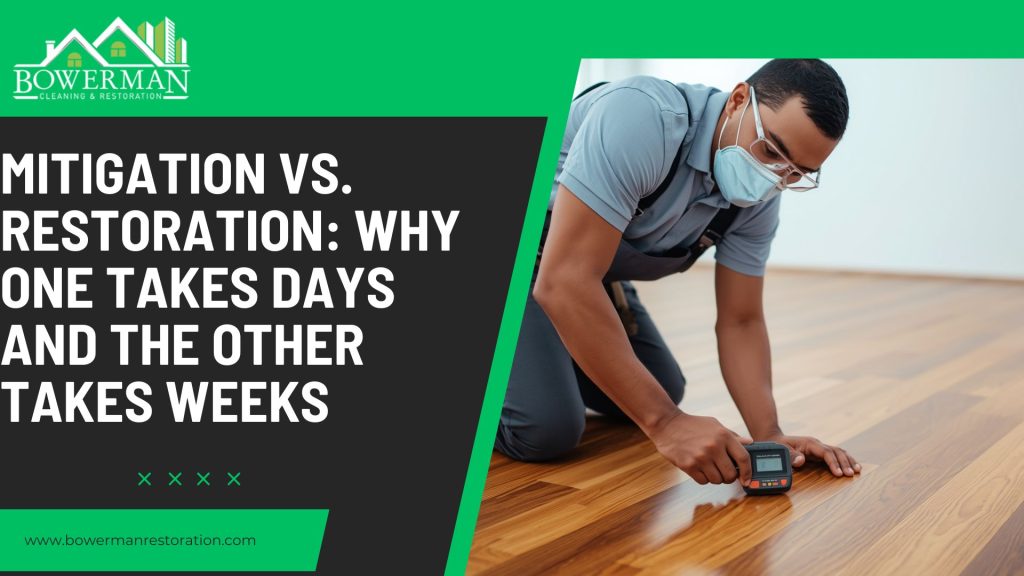
You are standing in your living room, listening to the hum of industrial fans. The carpet is pulled up, the baseboards are gone, and a dehumidifier is draining water into a sink. It has been two days since the pipe burst, and you just want your home back. It is the most common question we hear in this situation: “How long is this going to take?”
The answer requires distinguishing between two very different phases of recovery. Water mitigation—the process of stopping the damage and drying the structure—is a sprint. Restoration—the process of rebuilding—is a marathon. Understanding how long does water mitigation take versus how long the entire project takes is critical for managing your expectations and your insurance claim.
If you rush the mitigation, the restoration will fail. Painting over wet drywall or laying new floors on damp concrete is a recipe for mold and wasted money. This guide breaks down the realistic timelines for drying your home, the hidden factors that can extend the clock, and why patience during the first few days is the fastest way to get your life back to normal.
Key Takeaways
- The 3-5 Day Rule: Standard water mitigation typically takes between 3 and 5 days to reach the dry standard.
- Material Density Matters: Hardwood floors and plaster walls take significantly longer to release moisture than drywall or carpet.
- The “Dry Standard”: Drying isn’t done when it feels dry; it’s done when moisture meters prove it matches the non-affected areas of your home.
- Class of Water: The amount of water (Class 1-4) dictates the speed. A soaked room (Class 3) takes longer than a damp corner (Class 1).
- Don’t Rush the Rebuild: Starting restoration before mitigation is 100% complete voids warranties and invites mold growth.
Overview
Water mitigation is the emergency phase of property recovery. Its sole purpose is to stabilize the home and prevent further destruction. This involves water extraction, demolition of unsalvageable materials, and the strategic application of airflow and heat. Restoration is the construction phase that follows, involving drywall installation, painting, and flooring.
While restoration can take weeks depending on contractor schedules and material delivery, how long does water mitigation take is largely dictated by physics. We can encourage water to evaporate, but we cannot break the laws of nature. On average, a professional mitigation job lasts 3 to 5 days. However, variables like the extent of the saturation, the type of water (clean vs. sewage), and the local humidity in Westchester and Fairfield counties can influence this timeline. This article provides a day-by-day breakdown so you know exactly what to expect.
The Standard Timeline: Days 1 through 5
When you hire a professional team, the clock starts immediately. Here is a typical workflow for a standard residential water loss.
Day 1: Emergency Response and Stabilization
The first 24 hours are the most critical. Our team arrives to stop the source of the water (if active) and perform emergency extraction.
- Physical Removal: We use truck-mounted vacuums to pull standing water out of carpets and floors. Removing water in its liquid state is 1,200 times faster than waiting for it to evaporate.
- Demolition: We remove wet padding, soaked insulation, and baseboards to open up wall cavities.
- Equipment Setup: We install high-velocity air movers and LGR (Low Grain Refrigerant) dehumidifiers.
Day 2: Monitoring and Adjusting
By day two, the surface water is gone, and the equipment is working on the “bound water” trapped inside the materials.
- Readings: We take moisture readings of the air and the affected materials.
- Adjustments: We might reposition fans to target stubborn wet spots.
- Odor Control: If necessary, we apply antimicrobial treatments to prevent musty smells.
Day 3: The Turning Point
For many minor losses (Class 1 or 2), day three is when we hope to see materials approaching the “dry standard.”
- Drywall Assessment: Standard drywall often dries by this point.
- Decision Time: If materials are not drying fast enough, we may have to remove more of them (e.g., cutting more drywall) to save the studs behind them.
Days 4-5: Difficult Materials and Completion
If the loss involved hardwood floors, double-layered drywall, or plaster, drying often extends to day four or five.
- Final Verification: We compare the moisture readings of the wet area to a dry, unaffected area of your home. If they match, the mitigation is complete.
- Equipment Removal: We pack up the fans and dehumidifiers.
- Transition: We sign off on the Certificate of Drying, signaling that restoration can begin.
Factors That Extend the Timeline
While 3-5 days is standard, several factors can answer how long does water mitigation take with “longer than expected.”

1. Class of Water (The Volume)
The IICRC classifies water damage by the amount of water and the rate of evaporation.
- Class 1 (Least): Only a part of a room is wet. Fast drying (3 days).
- Class 4 (Specialty): Water has saturated deeply into bound materials like hardwood, plaster, or concrete. This requires specialty equipment and heat drying, often extending the process to 7+ days.
2. Category of Water (The Contamination)
If the water is Category 3 (sewage or floodwater), the timeline changes. We cannot just dry it; we must sanitize it.
- Cleaning Phase: We must physically remove all porous materials (carpet, drywall) and pressure wash/scrub the framing before drying even begins.
- Clearance Testing: We often have to wait for an industrial hygienist to pass the site as safe before we can declare mitigation finished.
3. Material Density
Drywall is porous and dries fast. Hardwood is dense and dries slow. Concrete is extremely dense and releases moisture very slowly. If your basement slab is saturated, it might take a week or more to dry sufficiently to accept new flooring adhesive.
4. Exterior Weather
In humid areas like Nyack and Stamford, the outdoor air can work against us. If it is raining and humid outside, we cannot open windows. We rely entirely on dehumidifiers. In extreme cold, frozen pipes can complicate the process, requiring us to heat the structure before we can dry it.
The Danger of “Stopping Early”
Homeowners often ask, “The carpet feels dry, can you take the fans?” We understand the noise is annoying, but stopping early is dangerous.

The “Dry to Touch” Fallacy
Your hand can feel surface moisture, but it cannot feel the moisture content inside a wood stud. If we remove the equipment when the stud is at 18% moisture content (safe is usually 10-12%), that remaining moisture is trapped when you paint the wall.
- Result: Mold grows inside the wall cavity.
- Consequence: You have to tear the wall out again in six months.
Professional water damage restoration relies on data, not touch. We do not remove equipment until the meters confirm the structure is stable.
Mitigation vs. Restoration: Managing the Gap
Once mitigation ends, there is often a pause before restoration begins. This gap can be frustrating, but it is necessary.
The Insurance Adjuster Review
The insurance adjuster needs to review our drying logs and the scope of the damage to approve the budget for the repairs. Because we provide detailed documentation of the drying process, this approval is usually faster for our clients.
Material Lead Times
While mitigation uses equipment we own, restoration uses materials you have to choose. Ordering matching flooring, custom cabinets, or specific paint colors takes time. This is why the “restoration” phase is measured in weeks, while how long does water mitigation take is measured in days.
Why You Need a Unified Team
The transition from drying to rebuilding is where most projects stall. If you hire one company to dry and another to build, you face communication delays.
The Bowerman Advantage
By handling both steps, we eliminate the friction.
- Seamless Handover: Our mitigation project manager briefs the construction manager directly.
- No Finger Pointing: We are responsible for the entire warranty. We don’t blame the “drying guy” if the floor buckles, because we are the drying guy.
- Faster Claims: We submit a comprehensive package to your insurance, often speeding up the payout for the reconstruction.
Protecting Your Home During the Wait
While the fans are running, you can take steps to help the process.
- Keep Windows Closed: Let the dehumidifiers control the environment.
- Leave Equipment On: Turning off fans at night extends the drying time significantly.
- Keep Doors Open: Interior doors should remain open to allow airflow to circulate between rooms.
- Move Valuables: clear tabletops and floor areas to give our technicians easy access to check moisture points.
When to Call for Help
If you have standing water, the timeline for recovery depends on how fast you call. Waiting even 24 hours allows water to soak deeper, turning a 3-day drying job into a 7-day drying job.
Bowerman Cleaning & Restoration
Locations Serving You:
- White Plains: 7 Intervale Street, White Plains, NY, 10606 (+1 844 269 3762)
- Nyack: 99 Main St, Nyack, NY, 10960 (+1 844 269 3762)
- Stamford: 6 Landmark Square 4th Floor, Stamford, CT, 06901 (+1 844 269 3762)
We are ready to start the clock on your recovery immediately. We offer:
- 24/7 Service: We answer the phone whenever disaster strikes.
- Free Inspections: We establish the drying plan before you pay a dime.
- 50+ Years Experience: We have the expertise to dry complex structures efficiently.
- Family Owned / Operated: We care about getting you back into your home.
- Eco-Friendly Products: Safe solutions for your family and pets.
- Locals / Local Expertise: We understand the specific construction styles of the Tri-State area.
- Certified Excellence: IICRC certified and licensed in mold remediation.
- Home Improvement License: We handle the rebuild so you don’t have to hire a second contractor.
- Proven Track Record: Our reputation is built on successful completions.
Common Questions About how long does water mitigation take
Q: Can I stay in my house during the 3-5 days of mitigation?
A: Usually, yes. It will be loud (like a vacuum cleaner running constantly) and warm (dehumidifiers generate heat). If the water loss is in a critical area like the kitchen or only bathroom, or if it is a sewage loss, you may prefer to stay in a hotel. Insurance often covers “Additional Living Expenses” (ALE) in these cases.
Q: Why does the equipment have to run 24/7?
A: Drying is a continuous cycle. If you turn the equipment off, the moisture deep in the materials migrates back to the surface, undoing the progress made during the day. Consistent airflow is required to maintain the rate of evaporation.
Q: What if it takes longer than 5 days?
A: If we are drying dense hardwoods, concrete, or double-sheeted firewalls, it can take 7-10 days. We will inform you and your insurance adjuster if the drying goals require an extension. This is common in Class 4 water losses.
Q: Does the 3-5 day timeline include fixing the walls?
A: No. That timeline answers how long does water mitigation take (drying). Putting the drywall back, painting, and reinstalling flooring happens after mitigation is certified complete. That is the restoration phase.
Q: Can I open the windows to help it dry faster?
A: Generally, no. Modern drying equipment creates a very specific low-humidity environment. Opening windows introduces outside humidity (especially in NY/CT summers), which can actually slow down the drying process and overwork the dehumidifiers.
Q: How do you know when it is actually dry?
A: We use a “Dry Standard.” We take moisture readings from a dry, unaffected part of your house (like a bedroom that didn’t flood). That is our target. When the wet area matches those readings, we know it has returned to its natural equilibrium.
Q: Will my wood floors have to be ripped out?
A: Not always. If we respond quickly (within 24 hours), we can use specialized floor mat drying systems to save hardwood. However, this process often takes longer than standard drying (up to 7-10 days) and depends on the finish and subfloor type.
Q: Who pays for the electricity used by the fans?
A: The equipment does use electricity. However, since it is required for the claim, you can often submit the increase in your electric bill to your insurance company for reimbursement as part of the claim.
Conclusion: Patience Pays Off
The urge to “just get it done” is powerful, but in water damage, shortcuts lead to mold. Knowing how long does water mitigation take helps you plan your life during a chaotic week. It is a 3 to 5-day disruption that saves your home from a lifetime of structural issues.
Trust the process, trust the data, and trust a team that knows the difference between “dry to the touch” and “dry for good.”
Contact Bowerman Cleaning & Restoration Today for Your Free Inspection
Author & Process: This guide is based on the IICRC S500 Standard and Procedure for Professional Water Damage Restoration. It is designed to provide homeowners with realistic expectations regarding drying timelines and the importance of scientific verification in property recovery. For more on our integrated services, visit our Nyack Restoration Services page.